Sunday, April 13, 2008

Compassion according to Josefa (our new Guatemalan Bridges blogger)


Hola! My name is Josefa Elizabeth Ratzan Petzey and I live in a pretty pueblo on a beautiful lake full of beautiful people with beautiful traditions called Santiago Atitlan in Guatemala. This is my first time out of the country.

I believe compassion is giving love to people for friendship. One must share all of themselves in schools and in religion and never judge color of skin or culture. School teachers should have good relationships with their students because children are the future. Having compassion with children is building peace for the world and forming societies of love. Religion is a good place to share with others and help, support, and love people.

In Guatemala there is so much discrimination of indigenous pueblos like mine, Santiago Atitlan. There is discrimination of our dress. Some time there is so much violence and people are killed. If they had good relations they could plant a good future.

Friday, April 11, 2008

Compassion according to KT

Today I got a chance to see His Holiness The 14th Dalai Lama in a conference of Seeds of Compassion where he answered the questions given by some famous scientists on compassion. I really liked it a lot because the way he spoke and the way he answered those questions was really wonderful.

I come from the same country, same city, and the same town where he lives. Dharamsala is a small town where the Tibetan people try their best to control their anger and be more compassionate but unfortunately the environment out there takes advantage of it and sometimes they can’t be compassionate. You would find different kind of Tibetans, both patient and arrogant, but it doesn’t matter whether or not they are arrogant everybody loves and worships His Holiness The 14th Dalai Lama.

From my point of view His Holiness does want to go to his own country Tibet, but if we return to our home and don’t find any family members it won’t feel like home. So I think it’s the same with His Holiness - he wants to go to Tibet with his people and stay out there as he used to, before 49 years ago.

I also want to go to Tibet where I haven’t been. I think that it would be a little hard to adjust out there. I think we can’t always expect the good to happen because whenever you get something good there is also a bad which accopmanies it. As we are the 21st century's generation and we have been growing up using the modern technologies, it would be hard in Tibet to not to be using it anymore because the people in the remote areas don’t have the access to the technologies. It is different in the city because the Chinese have changed it into a very modern place.

Tenzin Metok in a Seattle computer lab - Photo by Justin Hoch

The struggle of the Tibetan people is not towards the people living in China because I think that they are innocent and they do not have much idea what is happening in their government as the government in China is not a democratic type of government. Our struggle is with the people who are ruling China.

I think that I can show compassion towards the Chinese government by differentiating between the actor and his actions and taking appropriate measures towards it.

The Olympics in China should not be abolished because I think that through this the people who will go to see the Olympics will know a little bit about Tibet and know that Tibet was not a part of China. I think that more people aware of Tibetan people because of the Olympics is better than being aware from the protesting because due to the protests hundreds of innocent Tibetans are being killed unnecessarily.

I think that we all can develop compassion by lessening others' suffering trough consoling or comforting them and also by reducing one's own egoistic thinking and thinking for others' happiness and wishing for others' well being. Today I learned from His Holiness that the problems we have are due to our own way of seeing them. Compassion can also be developed with a calm and peaceful mind.

Compassion according to Sese

For the first time in my life I attended one of the world’s biggest events and saw one of the world’s most respected people, His Holiness the 14th Dalai Lama. Listening to his words and answering the questions that were thrown at him by scientists, I felt it was wonderful how they had a conversation about how compassion begins and at what stage we feel empathy and compassion.

I learned that compassion is within us from birth and as we grow up certain circumstances and challenges changes our lives and compassion starts disappearing. It takes a long time to realize that we’ve always had compassion.

I come from a small township in Cape Town called Wallacedene which is South Africa and a lot of people have lost their sense of compassion because of the problems that we are facing like crime poverty and lack of jobs. So every body does not care about anybody else but himself. Today I realized that there’s still a chance for them to bring the feeling of compassion back if they can reach out and get to see the other parts of the world, experience how life is on the other parts of the world.
For me compassion is something that I have always had for any person that I come across with. But there were times when I could show it to other people and there were times when I couldn’t see compassion in action. Sometimes I felt like having compassion only towards my friends and family because I thought that they were the only important things to me. But through understanding compassion I felt very bad of the way I treated other people before and made it up to them.

When I look at the history of my country and how people were treated during the apartheid laws I don’t have that grudge in me. I feel that we have to go back to that history and find a way to forgive and forget, to show love and compassion and unite together as one.

I understand that it is not easy to just forgive and forget but if we would all have the same understanding about compassion and what role it plays in our lives we would have the feeling of forgiveness within us.

Seattle student Ali's reflection on the visiting students

Hi! I’m Ali Johnson. I’m 14 years old and in eighth grade at Salmon Bay School in Seattle, Washington. Next year, I will go to high school at the Northwest School. I love playing sports, dancing, singing, traveling, and being with my friends and family.

Recently, at Salmon Bay, we have had some visitors: Tibetan students from the Tibetan Children Village School (TVC) in Dharamsala, India and students from the Hector Peterson School located in Cape Town, South Africa.

When we first met the Tibetan students, I was excited, but also a little nervous. I wanted them to like me, and I didn’t want them to think of me as a spoiled American girl. I don’t quite know what they made of me, but I really like them, they were very friendly, they smiled and laughed a lot and exuded an air of happiness that was fun to be around.

(Photo by Bridges mentor Justin Hoch)

However, I didn’t really get to know any of them until the Bridges to Understanding meeting, where the small blogging group (there are five of us, including our mentor, Cheryl) met up and had a discussion on what we wanted to write about. KT (from TVC) and Sese (the first South African that I met) were in the group. At first glance, both of them could have been American - they wore similar clothes to me, and spoke English well and fluently (I’m extremely jealous of their multi-lingual education). It was only once we started talking about schools and homes that I realized things were very different.

KT and Sese’s countries have both been under oppression. KT’s homeland of Tibet is currently occupied by China and for many years South Africa was under Apartheid rule enforced by the Afrikaans (English and Dutch colonizers). For me, it is hard to understand what having something this important directly linked to you would feel like. Although at one point, America was also under British rule, it was much too long ago to have a direct impact on me.

I have learned about both the Apartheid rule and Tibet’s current conflict with China, but meeting Sese and KT and listening to them talk so calmly and factually about past and present issues in their countries, helped me understand that though bad things have happened and are happening now, its no reason to be pessimistic.

However, the realizations weren’t over yet. Yesterday, Sese, and his friends came and spent the day at my school. They played ultimate Frisbee, Lacrosse, and gave a dance lesson to the whole middle school.


South African students teach dance to Salmon Bay students

My friend Devin and I wanted to talk to them some more, so when it came time for lunch, we sat down at their table and struck up a conversation. At first, it was just the regular things, birthdays, ages, grades, Seattle, but then they asked us one of the hardest questions: “What challenges do you face as a teenager?” I was unsure of how to respond.

Was I supposed to say that it was hard to convince my parents to let me get a cell phone? I doubted it. Devin and I looked at each other; we didn’t want the South Africans thinking that we faced no challenges in life, even though, for the most part, that was true. Sese and Phuti, seeing our confused faces, tried to help us out; “For instance, we have problems with teen pregnancy and HIV/AIDS” they offered, adding more as our confusion turned to panic. Of course, we have problems like that in America, they just don’t really relate to my daily life and when it comes to facing challenges, who am I to compete against them? Devin finally broke the awkward silence by mentioning the crime in his neighborhood, and I felt compelled to say something too. In the end, I talked about people doing drugs, drinking alcohol, and having sex when they were teenagers. However, since I live “above the influence” and it’s a rare occasion that I’m in a situation where people would try to peer pressure me into doing any of those things, I felt like I wasn’t being entirely truthful.

If I had it to do over, I would probably talk about the powerless sort of feeling that being a teenager involves. I’m old enough to understand the problems facing the world, I’m just not sure how to go about helping them, and even if I am, I usually am not equipped to accomplish these actions. I’m not using my age as an excuse; I try to help make positive changes in my community and in the world. I’m just saying that it would be substantially easier if people took teenagers, and my, opinion more seriously.

Monday, April 7, 2008

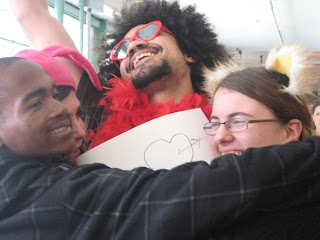
Huggers: Digital Story created by KT, Sese, Lhwang, Carrie, and Bridges staff

Transcription of digital story:

"Public Market Center is the biggest public market in seattle. We went there on the 4th of April 2008 to start our group's digital story. My name is KT, I am from India. There are in total 4 members in my group: first one, Lhawang, he is from India. Second Carrie, she's from Seattle. Third one is Sese, he's from South Africa, and the last one is I.

You would find different kinds of people in this center. They sell different kinds of things in it like flowers, seafood, magical items, flowers, candies, seafoods, etc. We passed our time at first by clicking photos of the seafoods andflowers as the market was crowded. In our group we all wereconfused and didn't know where to start from.

Then, suddenly Mr. Phil came with a weird dressed girl called Camber who was holding a chart written "free hugs" and he asked our opinion if we would be interested in making a digital story on her.


At first, it was quite weird to make a story on the huggers. There aren't any huggers in India and if there would be any huggers in India it would be kind of a joke and they would be make fun of. I didn't want to hug the huggers because it would be kind of weird, but then we moved on the positive side and made a conclusion that it would be unique.


Her name was Camber and she was with her other 4 friends, and they had divided the Pike Place market into 4 parts and went theirseperate ways to give hugs. She said that she gave hugs to try to spread more love and she and her friends thought that people should love each other.


Loving one another only doesn't mean to love a person you are related with. You can also love a person due to humanity. She got this idea of hugging others by knowing about the bad relationships between the humans in the different countries and how they ignored what was happening with them. She thought that she was a lovingperson and that hugging made her happy.

They all thought that the more the costumes were funny, the more they got the hugs. They all said that mostly the small kids and people above 40 hugged them and the teenagers and other people thought it kind of a crazy thing.


In my group there is a boy from South Africa called Sese. He hugged all the huggers at one time, and also hugs his friends...his teacher...everyone. He has got good sense of humor and he is a very jolly person, and he gets moved very quickly.


Hugging: we all love to hug our loved ones like your mom, your child, your father, or your friends. We all feel comfortable with it. But hugging the strangers is the most suprising thing. So, our group members would like to say that you don't need words to express your affection...you just need a hug.

Saturday, April 5, 2008

BRIDGES TO UNDERSTANDING AND WHAT IT MEANS TO ME: Sesethu


Honestly speaking, the first time Bridges was introduced to our school I was chosen as part of the learners that would be participating in the cultural exchange program. Back then, I never knew what Bridges was all about and I started to lose interest in the program because I was involved in many programs at school and I saw them as more interesting than Bridges. I ended up leaving the group that had chosen me.


Later, after the program started to grow and more people got interested in joining Bridges, to me it felt like I needed to go back because so many things were happening and the program itself was interesting as it unfolded itself to all the students in our school. I had a problem with finding my way back to the group because I never told anyone why I had left or knew how to explain what brought me back to the group again.

So as Bridges grew into this one big family of love, support, and encouragement things started to happen and all students began to understand what Bridges is all about. Opportunities started to appear to all learners as 6 students were chosen to go to Seattle. And when all of this happened I was sitting there and observing and blaming myself for letting such an opportunity go when I should have grabbed it with both hands. As I was observing the program, new things were being introduced to the learners like the photographic workshops they attended and the digital storytelling that they just did recently that informed me more about Bridges.

At the beginning of this year I was picked again to be part of the new group where I had been chosen before. I was so happy that I was called again, because to me this was my second chance and a chance I won't let go of. I wanted to be part of the group and be part of the cultural exchange with students in Seattle, not knowing that there was going to be another selection of 6 learners going overseas.

Luckily I was selected to be part of that group that has come to Seattle, and to tell the truth I was so happy but at the same time I couldn't believe that it was me who has been chosen.

So in my own understanding I would say that Bridges to Understanding to me is a home of compassion, a home where people give not because they want something in return but because they know that when you give whatever little that you have you are likely to get everything that you want in life.

As learners in the program, we are taught to love ourselves so that we may be able to love others as well, to help each other, to know where we come from and to show the love and kindness that we have within us to other people and that's what UBUNTU is all about.

I come from a community of informal settlements where it is hard for some families to put food on the table because people are not working. As a result some teenagers get themselves involved in crime, thinking that it's a way of finding food for their families.

So, Bridges played an important role in our lives because it takes us out of the streets and provides us with opportunities, and when we have something to do after school there's no getting yourself involved in the violence happening outside.

-Sesethu